
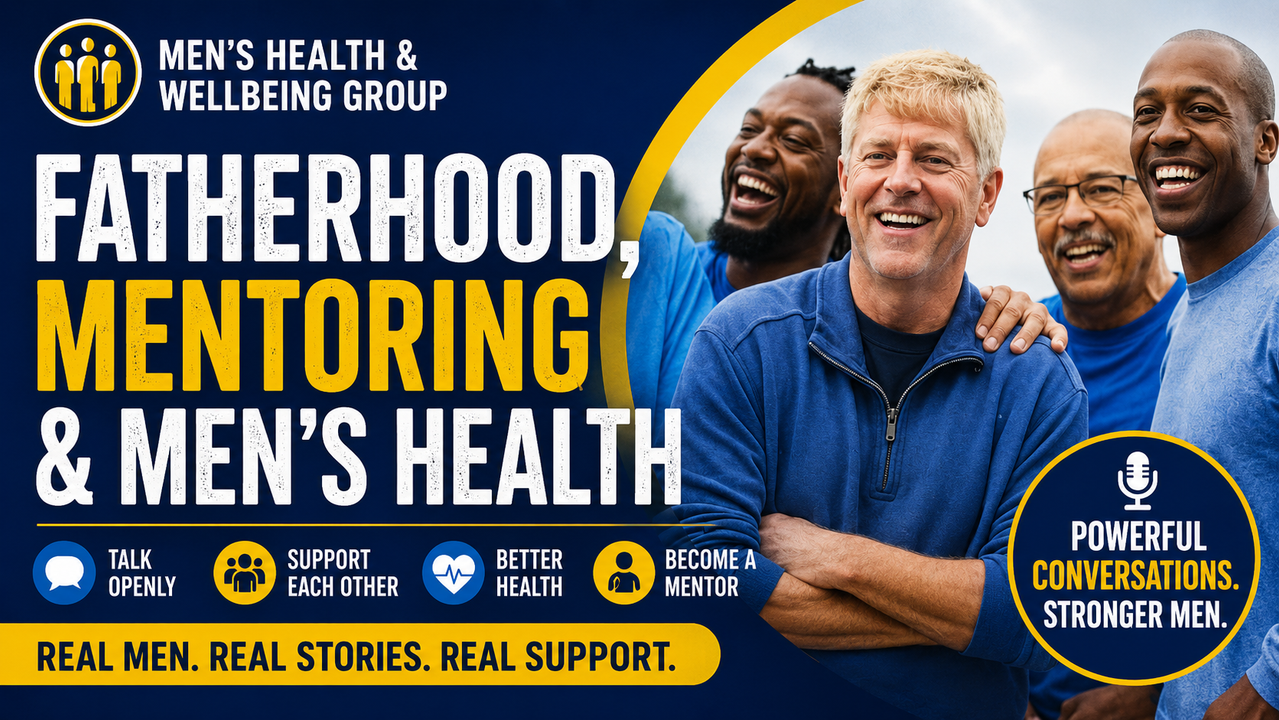
Fatherhood, Mentoring and Men’s Health: The Power of Showing Up
Published on July 14, 2026
Fatherhood, Mentoring and Men’s Health: The Power of Showing Up
Fatherhood. Mentoring. Men’s health. Real stories and honest conversations.
When men get together and speak openly, the conversation can go places that do not normally get said out loud. Relationships with fathers, the pressure of parenting, grief, regret, health, community, and the question of how we become a better example for the next generation.
That is what the Men’s Health & Wellbeing Group is about. No judgement. No pressure. Just a space where men can talk, listen, share experience and support one another through the things life throws at us.
A New Venue, the Same Purpose
Our monthly meetings have moved to Alexander Stadium. Sometimes a change of venue means a few people get lost along the way, but the important thing is that we keep moving forward. This move feels like a step up. It puts us in a place with more activity, more fitness around us, and more opportunity to build what we are trying to build.
To make things simpler, meetings will now take place on the last Tuesday of every month. That is easier to remember than trying to work out which Tuesday falls where each month.
Our links with the previous venue remain in place too. We still plan to hold focused workshops around issues that matter to men, including:
Mental health and wellbeing Prostate cancer awareness Diabetes One-to-one support where it is needed
This group is not only about one monthly meeting. A lot happens outside the room: building relationships, attending strategic meetings, promoting men’s health and collaborating with organisations that want to support men properly.
Building a Stronger Men’s Health Network
A key priority is working alongside other groups that share the same purpose. One of those connections is with Andrew Kissumba from Cedar Nations Church, who is developing a men’s group of his own.
This is not about forcing religion on anyone. It is about recognising that men need places where they can get support with health, wellbeing, family life and the wider challenges they face. There is real synergy in working together.
The group also has a committed committee behind it. Gordon brings lived experience of prostate cancer and understands the ups and downs of that journey. Glenville supports the health and wellbeing activity. Barrington brings his marketing and AI background to help develop the group’s digital presence.
Small grants help make this work possible, although funding always comes with requirements around reporting and monitoring. We will remain a men’s group with men’s health and wellbeing at the centre of what we do, while treating people fairly and ensuring nobody is excluded or judged.
Website and Men’s Health Expo Plans
The group’s website is now live at mhwg.co.uk. It is a place to keep up with meetings, activities and future developments. The previous website address redirects to the new one, so no one should lose access.
Work is also beginning on a Men’s Health Expo planned for the coming months. That will need a proper team around it, people who are willing to contribute ideas, contacts, practical support and energy. A health expo can only work when it brings the right information and support into the same room as the men who need it.
Fatherhood Starts With Honest Questions
Fatherhood is not a simple subject. Some people had fathers who were present and loving. Others had a father who was physically there but emotionally absent. Some grew up with strict discipline, inconsistency, conflict or separation. Others have spent years wishing they could ask a father one more question.
Two useful questions can open up an important conversation:
What do you wish you had known or learned from your father? As a father or father figure, what do you wish you had done differently?
These are not questions to shame anyone. Most men are doing the best they can with what they were given. But honesty matters, because understanding what was missing can help us decide what we will pass on differently.
The Loss of a Father and the Need for Community
Andrew grew up in Uganda during the Idi Amin regime. His father, a hospital leader who was known for speaking up when he believed something was wrong, died when Andrew was eight years old.
It was a devastating loss. There were questions that could never be answered: what would his father think of the man he became, the choices he made, or the life he built?
Not every father is lost through death. Sometimes a father is alive but unavailable. Sometimes there is no relationship, no conversation and no connection. The impact can still be deep.
In many African communities, there is a saying: it takes a village to raise a child. In Andrew’s culture, the words for uncle and father are the same, and the words for auntie and mother are the same. Children belong to the wider community. Adults are expected to guide, correct and protect them.
That sense of community matters. No man is meant to carry everything alone. We all need people around us who can help keep us grounded, challenge us when necessary and remind us who we are.
Three Stories of Fathers Trevor: A Father Who Was Never Present
Trevor shared a painful experience of growing up around a father he barely knew. He lived in the same house as him for years, yet there was no conversation and no relationship. He did not even know his father’s name for much of his life.
His father was physically present on the earth, but not present in Trevor’s life. That is a hard truth, and it shows why presence matters so much. A child needs more than someone in the building. They need to be acknowledged, spoken to, cared for and known.
Dez: Strict Discipline and Lasting Influence
Dez described a father who could do something wonderful one moment and then be extremely harsh the next. There was little consistency. His father was a strict disciplinarian, and family life was complicated by separation, legal battles and difficult relationships.
Yet Dez also recognised that his father gave him something valuable. If he asked a question about the world, history or practical matters, his father would answer directly and show him evidence. He taught him not to make claims lightly and to be able to prove what he said.
That is an important reminder. People can leave both wounds and lessons behind. Recognising the good does not erase the bad, but it can help us choose what to carry forward and what to leave behind.
Earl: Separation, Reconciliation and Dementia
Earl’s father was hardworking and provided for the family, but his life was also shaped by gambling, conflict and other relationships. When Earl was 13, his parents separated and he had to grow up quickly. As the oldest child, he took on responsibility for younger siblings while his mother worked.
Later, Earl built a life in music, playing keyboards in a reggae band during the punk era. His father came to the gigs and proudly told people, “That’s my boy up there.” It was one of the brighter periods in their relationship.
When Earl’s daughter became terminally ill, he reached out to his father and the family began to come back together. They rebuilt their connection through birthdays, Christmases, anniversaries and shared meals. There was a season when they became friends.
Then dementia arrived. Earl and his family visited and cared for his father across different nursing homes, even when he could no longer remember them. At his funeral in 2019, the turnout was massive. It was evidence that, despite the difficult parts of his life, he had touched many people.
One childhood memory stayed with Earl. After a fight between brothers broke the family television, everyone expected punishment. His father looked at the broken set, checked that no one was hurt and sent them to bed. He saw that beating anyone would not bring the television back.
That moment showed Earl a different side of his father: rational, thoughtful and emotionally controlled. Sometimes one decision can reveal the person someone is trying to become.
Finding Your Centre
Life can feel like a Rubik’s Cube. Everything starts off looking mixed up. Family experiences, bad choices, losses, pressure, anger, work, money, health and relationships can all leave us trying to make sense of the pattern.
When solving a Rubik’s Cube, the centre squares do not move. They provide the reference point that helps everything else line up. Life needs a centre too.
For Andrew, that centre is Christ and the cross. It represents the meeting point of four things:
Evil, because evil is real and many people have experienced it. Justice, because people want what is right to matter. Love, because love has the power to heal and restore. Forgiveness, because no one can move forward while carrying every wrong forever.
Not everybody will express their centre in the same way, but everybody needs something steady. Builders use a plumb line and a spirit level to check whether something is straight. Men need a reference point too. Without it, it is easy to drift from one thing to another.
Community can help provide that stability. Being part of a group, having people who know your story and hearing other men’s experiences can help bring life back into alignment.
Four Habits That Shape a Man
Once a man has a centre, the next step is paying attention to the daily habits that shape his life. Four areas matter greatly.
- What You Say
Words matter. We have two ears and one mouth, so listening should carry real weight. When we are younger, it is easy to think we know everything. As life goes on, many of us realise we had more to learn than we thought.
The way we speak to ourselves, our children, our partners, our friends and other men can either build people up or tear them down.
- What You Take In
What goes into your mind and spirit eventually comes out in your life. The conversations you absorb, the media you consume, the messages you believe and the ideas you repeat all affect you.
Be careful about what you allow to shape your thinking. It is difficult to produce something healthy when everything going in is negative, destructive or hopeless.
- Where You Go and Who You Spend Time With
The people around you influence you. Birds of a feather flock together. Even if you are not smoking, standing in a room full of smoke means you come out smelling of it.
The same principle applies to company, environments and habits. Being in the wrong places repeatedly will pull your life in the wrong direction. Being around people who are trying to do better can help you do better too.
- What You Do
What you do with your hands and your time is important. Our choices become patterns, and our patterns become the direction of our lives.
There is an old principle that remains true: you reap what you sow. Play foolish games and you are likely to win foolish prizes. Small actions might seem insignificant on their own, but they add up.
Why Consistency Beats Talent
Many men start well and then get distracted. We say we will save money, then we spend it. We decide to eat better, exercise more or get a health check, but life gets in the way and the intention disappears.
The real challenge is not knowing what to do. Most of us know the basics. The real challenge is doing them consistently.
An RAF pilot once received some powerful advice while training for elite flying. He was trying to impress people with complicated moves and clever tricks, but he failed. An older man put his arm around him and told him to stop trying to be spectacular.
The advice was simple: do the basics consistently well, and you will be above average.
Most people do not consistently do the basics. Yet these are the things that build trust, character, health and stability:
Get out of bed and show up. Be on time. Keep your word. Do not spend more than you earn. Take care of your appearance. Speak to people properly. Learn people’s names. Smile and treat people with respect. Attend health appointments, including prostate checks where appropriate. Keep trying when progress feels slow.
Consistency matters especially in fatherhood and mentoring. It is not enough to be amazing one day and absent the next. Showing up regularly, being calm, keeping promises and being available creates trust over time.
Become the Mentor You Needed
For years, Andrew grieved the father he lost. He imagined the conversations they might have had and the guidance he might have received. Then he began to realise that different people had stepped into parts of that gap over time.
One person helped in one area. Another gave advice in another. The delivery was not always perfect, but the wisdom was often valuable.
That brought a shift in perspective. Maybe we cannot always receive the exact fathering or mentoring we needed. But we can become that person for somebody else.
Mentoring does not require a title. It can begin with simple questions:
What is your name? What is your story? How are you really doing? How can I help?
Every man has something to offer. A difficult childhood, a health challenge, a career lesson, a relationship breakdown, recovery from mistakes or simply the decision to keep going can all become encouragement for someone else.
Young people especially need examples they can see. They need to know that it is possible to overcome difficult beginnings, work hard, take responsibility and become a man of character.
The Penny That Doubles: Small Choices Create Big Change
Imagine being offered a choice: take £1 million today, or take one penny that doubles every day for 30 days.
At first, the million pounds feels like the obvious answer. On day one, the penny is just one penny. On day two, it becomes two pence. On day three, four pence. It does not look impressive for a while.
By day 10, it is only around £5.12. By day 20, it has reached just over £5,000. Then the growth starts accelerating:
Day 21: about £10,000 Day 22: about £20,000 Day 23: about £40,000 Day 24: about £83,000 Day 25: about £167,000 Day 26: about £335,000 Day 27: about £671,000 Day 28: about £1.3 million Day 29: about £2.6 million Day 30: more than £5.3 million
That is the power of compound growth. The same applies to the small, repeated choices we make every day.
One healthy meal does not transform your health. One workout does not make you fit. One conversation does not repair a broken relationship. One visit does not make you a mentor. One prostate check does not solve every health concern.
But repeated choices build over time. You get up. You show up. You make the call. You apologise. You save a little. You go to the appointment. You listen better. You encourage someone. You try again.
Sometimes it feels like nothing is happening. Keep going. The results are often building in the background before they become visible.
Be Present, Be Consistent, Be the Example
Some things in life look valuable but are not. Paper money has value because people agree that it does. But the things that truly change families and communities are often much simpler.
Be present. Be dependable. Be willing to listen. Be a man of your word. Learn from what happened to you, but do not allow it to define the limit of what you can become.
Whether your story includes a loving father, an absent father, a difficult relationship, grief, forgiveness or the need to start again, you still have something to give.
Show up. Share your story. Let somebody learn from it. Be the role model that a young person, a son, a neighbour or another man may not have had.
Small actions, done consistently and done well, can leave a legacy far greater than we realise.
Men’s Health and Wellbeing Support
The Men’s Health & Wellbeing Group exists to create a welcoming space for conversations about physical health, mental wellbeing, relationships, family life, parenting, prostate cancer awareness, diabetes, personal growth and life’s challenges.
Meetings take place on the last Tuesday of every month. For information about upcoming events, workshops and the Men’s Health Expo, visit mhwg.co.uk.